Theme #2 Culture change interventions

Why managers gain more from science than quick tips

Rita van Dijk interviews Dolf van der Beek, David Polinder and Alex Straathof, november 2025

Every manager is familiar with the promise of ‘proven effective interventions. An online search yields endless lists of tips, tools and training methods — yet solid scientific evidence that they work is often lacking. And even when there is evidence, it usually concerns isolated interventions: a training course here, a feedback session there.

What’s missing is an integrated approach that does justice to the complexity of organisations and to what that means for cultural change. That’s the focus of my conversation with three experts who have joined forces to combine evidence-based interventions from different fields.

I speak with Dolf van der Beek, senior consultant for safety and health at TNO; David Polinder, expert in Organisational Behaviour Management (OBM), and Alex Straathof, specialist in cultural change. Their mission is to merge insights from behavioural and cognitive psychology, social psychology and management science into one coherent approach that works.

Their framework, set out in a forthcoming white paper titled Safety Culture Evolution Framework (SCEF) to be published at the end of 2025, is already being applied in organisations. It also forms the basis for further research. The preliminary conclusion: managers can gain a great deal by taking science more seriously but only when they apply it in an integrated way, not as a collection of disconnected parts.

Why this collaboration was needed

The initiative for this collaboration came from Dolf van der Beek, who observed that many organisations struggle to build a genuine safety culture. “What strikes me,” he explains, “is that the word culture is often used when people mean behaviour. Culture is also about beliefs and assumptions, but these are rarely made operational in practice. Everyone says that safety culture matters, yet there is little proof that the usual methods improve safety performance.”

He delved into the research literature which led him to the work of Alex Straathof, who studies beliefs and group dynamics. Through an online search he also came across David Polinder, a specialist in OBM and applied behaviour analysis. “From our very first conversation, it was clear that our disciplines complemented each other beautifully,” says Dolf van der Beek. “Each of us brings a crucial piece of the puzzle.”

The core of the approach: four factors that drive behaviour

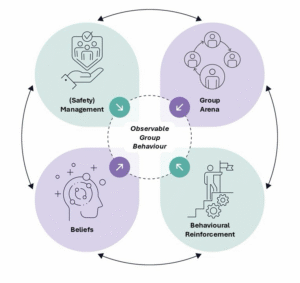
The collaboration produced a model that focuses on four scientifically validated factors shown to have the greatest impact on behaviour:

1. (Safety) management: policies, rules, procedures and structures.

2. The group arena: formal and informal team dynamics.

3. Behavioural reinforcement: strengthening behaviour through positive consequences.

4. Beliefs: the mindset of individuals and groups.

The model links these factors to observable group behaviour. “One key insight,” says Dolf van der Beek, “is that multi-faceted interventions are more effective than stand-alone actions. A training course on its own rarely changes much. But when you combine policy measures, reframing, group influence and reinforcement, you dramatically increase the chances of lasting change.”

The power of combined disciplines

Behaviour: what you can see and measure

David Polinder contributes the behavioural psychology perspective. He works with Organisational Behaviour Management (OBM), a methodology derived from applied behaviour analysis.

“Applied behaviour analysis is evidence-based and supported by more than 60,000 scientific studies,” he explains. “OBM builds on that foundation. It teaches us to look systematically at behaviour: what exactly do people do, and what are the consequences? Many interventions within OBM are proven effective, especially positive reinforcement, but also goal setting and feedback.”

“Challenging goals lead to higher motivation and better performance than vague or easy ones”
David Polinder

Setting goals, says David Polinder, does not automatically lead to behavioural change. “It’s about how you set them. The Goal Setting Theory has shown that specific, challenging goals lead to higher motivation and better performance than vague or easy ones. And it’s even more effective when positive consequences are linked to achieving those goals.”

Positive reinforcement, he emphasises, is central within OBM: “People are motivated when desired behaviour is rewarded immediately and appropriately. That reward can take many forms: recognition, appreciation, a compliment, greater autonomy, or something tangible. The preferred form differs per person. That personal fit is what makes reinforcement powerful. A lack of recognition and appreciation, after all, is the number one reason people leave an organisation.”

OBM follows a clear protocol: specify, measure, analyse, provide feedback, set goals, reinforce and evaluate. This makes behavioural change within organisations concrete and manageable.

Cognition and group dynamics: what people think and how groups function

Alex Straathof focuses on beliefs and the group arena and here too, the evidence base is strong.
“People don’t behave neutrally,” he explains. “Their beliefs drive their emotions and actions. How you interpret a situation determines how you respond to it. Understanding those cognitive constructs helps explain behaviour and it’s also a starting point for changing it. Group dynamics play a major role too: who holds influence, what’s seen as normal, and how power is distributed.”

“Reframing is a powerful tool”
Alex Straathof

He illustrates this with an example from his work at a housing corporation: “After a merger, different parts of the organisation interpreted the new code of conduct in very different ways. For some, ‘using company facilities’ meant buying a kitchen at cost price; for others, it meant taking leftover glue. By discussing these dilemmas in groups and reframing them, people suddenly realised this could amount to tax fraud — benefits in kind that both employer and employees were required to declare. That new narrative completely reframed the issue. Reframing is a powerful tool.”

Group dynamics are equally crucial. “There are differences in power in every team”, Alex Straathof continues. “Change those power relations, for example, by appointing a new team leader or redistributing responsibilities, and behaviour changes too. That’s often faster and more effective than individual training. There’s solid scientific evidence for the effects of group pressure and the influence of leaders’ example behaviour.”

Safety management

Dolf van der Beek brings in the management dimension. “In safety management, you first check whether people are even able to display the desired behaviour. Are the policies and procedures clear? You also look at occupational hygiene interventions.”

Such interventions aim to minimise workplace risks following a hierarchy of controls, starting with the most effective measures and ending with personal protective equipment. The highest level, source elimination, might mean replacing a hazardous substance with a safer one. The last line of defence includes items such as gloves, goggles or respirators.

“Our review of the scientific literature shows that measures higher up in that hierarchy are the only interventions demonstrably effective in permanently improving safety in high-risk industries, although relatively few effectiveness studies have been conducted,” says Dolf van der Beek. “When source or technical measures aren’t possible, we move to so-called collective measures, where improving safety culture is one option. These include skills training, enhancing communication patterns and influencing behaviour. Essentially, it’s about changing collective behaviour patterns. But change must be absorbable for the organisation. You can’t turn everything upside down overnight. That’s why we always build on existing structures and improvement processes. It keeps things manageable and effective.”

From isolated elements to an integrated whole

The real innovation lies in the integration. “We discussed this extensively,” says Dolf van der Beek. “In the end, we chose a fully integrated approach. We show how policies, beliefs, group dynamics and behavioural reinforcement interconnect and strengthen each other.”

He offers a simple example: walking routes in factories. “The goal is to separate traffic flows to prevent collisions. Sounds straightforward, but behaviour doesn’t automatically follow. So, you ask: is there a policy that mandates walking routes? Is compliance reinforced with compliments or sanctions? How does the group view it, and do informal leaders follow the rules themselves? What beliefs exist: do people see the value, or do they find it exaggerated? Only when you address all these factors simultaneously, you will achieve lasting change.”

Elaborated SCEF model

Practical lessons for managers

What can managers apply right now? The three experts offer several lessons:

1. Start with concrete behaviour. Alex Straathof: “Ask yourself: what exactly do you want people to do or stop doing? Make it observable. Only then can you measure and influence it.”

2. Investigate causes. David Polinder: “Are people able to display the desired behaviour? Are there reinforcing factors keeping unwanted behaviour in place?”

3. Use shaping. Reinforce small steps rather than expecting one big leap. David Polinder: “Celebrate successes and share them. That’s how you build momentum.”

4. Make it absorbable. Dolf van der Beek: “Don’t change more than the organisation can handle. Build on existing structures, or you’ll waste energy.”

5. Don’t forget beliefs and group pressure. Alex Straathof: “Behaviour is more than rational choice. Mindset and group dynamics often determine the outcome.”

Beyond safety: broader applicability

Although the framework was initially designed to develop a safety culture, it has far broader applications. “The four scientific dimensions are just as relevant for integrity, diversity, collaboration, you name it,” says Alex Straathof. “In every domain, you need sound policies, awareness of prevailing beliefs, an understanding of group pressure, and consistent reinforcement of desired behaviour.”

He gives an example relating to integrity: “It starts with policy — a complaints procedure, a confidential adviser, clarity about what counts as ethical or unethical. Then you ask: what beliefs justify deviant behaviour? What group pressures are at play? And how do you reinforce the desired conduct? The underlying change principles are the same.”

What still needs to be researched

One open question remains: how exactly do the different interventions interact? “We know they reinforce each other,” says Dolf van der Beek, “but the mechanisms aren’t yet fully clear. Over the coming years, we’ll analyse real-world data from the companies we work with to build a large database that will allow us to identify the combined effects of behavioural interventions. We hope this will confirm that true effectiveness lies in the interaction between them.”

David Polinder adds: “OBM has shown that context and environment matter enormously. Reinforcement works but timing and form are crucial. What works for one person won’t necessarily work for another. The same applies to the integrated approach: we still need to discover which combinations are most effective in which contexts.”

Conclusion: science as an ally

The three experts agree: managers don’t need to rely on vague culture programmes or passing fads. Science offers robust, proven interventions for cultural change. Their joint approach shows that these interventions become truly powerful when applied in an integrated way. Each discipline — policy, behavioural analysis, beliefs and group dynamics — has its own value, but together they create a far greater and demonstrable impact.

A strong foundation already exists for managers to put into practice. The puzzle isn’t yet complete, but one thing is certain: those who combine science and practice intelligently have a much greater chance of achieving real cultural change.

About the experts

Dolf van der Beek MSc


Dolf van der Beek is senior consultant for safety and health at TNO. Trained as an Occupational Health Psychologist, he researches the influence of human and organisational factors on workplace safety and health. His expertise includes operational risk management, safety culture and behaviour, (team) resilience, safety indicators, risk-group protection and safe human–robot interaction.

He works as consultant and IPMA-certified project leader in both research and advisory projects across multiple sectors and regularly publishes on safety and health issues in scientific and professional journals.

David Polinder

David Polinder is an expert in Organisational Behaviour Management (OBM). He supports international organisations in developing and implementing training and programmes focused on performance improvement, behavioural change and culture development. He is a certified OBM trainer (post-academic programmes at VU Amsterdam, accredited by APMG International) and a founding partner of the university’s Behaviour Change Expertise Centre.


David Polinder is founder of the OBM Academy, a training institute for internationally recognised OBM courses, and Managing Director of ViaFormance. He also serves on the Advisory Board of Bureau Veritas Group, where he advises on independence, impartiality and public perception in certification and decision-making processes.

Dr Alex Straathof 

Alex Straathof graduated as a psychologist and was a managing partner at several management consultancy firms specialising in cultural change within the construction sector, housing associations, and public authorities.


In 2009, he obtained his PhD in Public Administration from Erasmus University, focusing on measuring cultural change. Subsequently, he spent twelve and a half years as Professor of Management of Culture Change at the Amsterdam University of Applied Sciences, leading a research team dedicated to organisational issues such as integrity, criminal infiltration, cultures of fear, and cultural frictions in inter-organisational collaboration.

He now works again as a consultant specialised in culture change.