Theme #3 Criminal interference

Cultural interventions against criminal interference

LONGREAD

Alex Straathof, October 2026

Would you notice if criminal activity would seep in your organisation?

For many managers and leaders, the answer is: only when it is too late. That is precisely why it is important not to wait until there are concrete warning signs or incidents before taking action. Organisations need to be able to recognise vulnerabilities earlier and equip employees to act when criminal interference begins to emerge.

This requires more than rules and procedures. Organisational culture also plays an important role. Employees need to be able to recognise warning signs, know what they can do about them and feel supported when they take action. This creates the early responsiveness organisations need to counter criminal interference.

But the need to develop this responsiveness goes beyond the individual organisation. Criminal interference can manifest itself in many different parts of society. Although we are investing more than ever in combating organised crime, criminal influence is not diminishing. This underlines the fact that enforcement and prosecution alone are not enough. Greater attention is also needed for the resilience of the organisations and sectors into which criminal influence can penetrate.

A new strategy

Drug crime affects neighbourhoods, young people, SMEs, the police, the Public Prosecution Service, judges, Customs, local authorities and care institutions. As a result, criminal ways of thinking and acting are becoming increasingly intertwined with different areas of social life. For example, Cobra fireworks are used in 50% of bomb attacks to settle disputes in residential neighbourhoods, whereas such incidents could previously be attributed almost entirely to conflicts within the criminal milieu. Profits from drug trafficking are also invested in assets such as cryptocurrencies, property and businesses. This means that assets that appear legitimate at first sight may have a criminal background.

The focus therefore needs to broaden from tracking down criminals to developing resilience within businesses and public organisations. If organisations themselves become actors in combating criminal interference, they can obstruct the criminal shadow economy on a much larger scale.

The challenge is therefore clear: organisations need sufficient internal responsiveness to recognise criminal interference at an early stage and respond appropriately. This article shows how cultural interventions can help build that responsiveness and make employees more resilient to criminal interference.

Increasing criminal influence in four stages

Criminal interference has circumstances and a history of development. If the planner of a transport company has been recruited by a criminal organisation, events will have preceded that recruitment. The same applies, for example, to a young company in urgent need of revenue that takes on its first major customer despite doubts about whether that customer is legitimate, only to be confronted later with unpaid bills and threats.

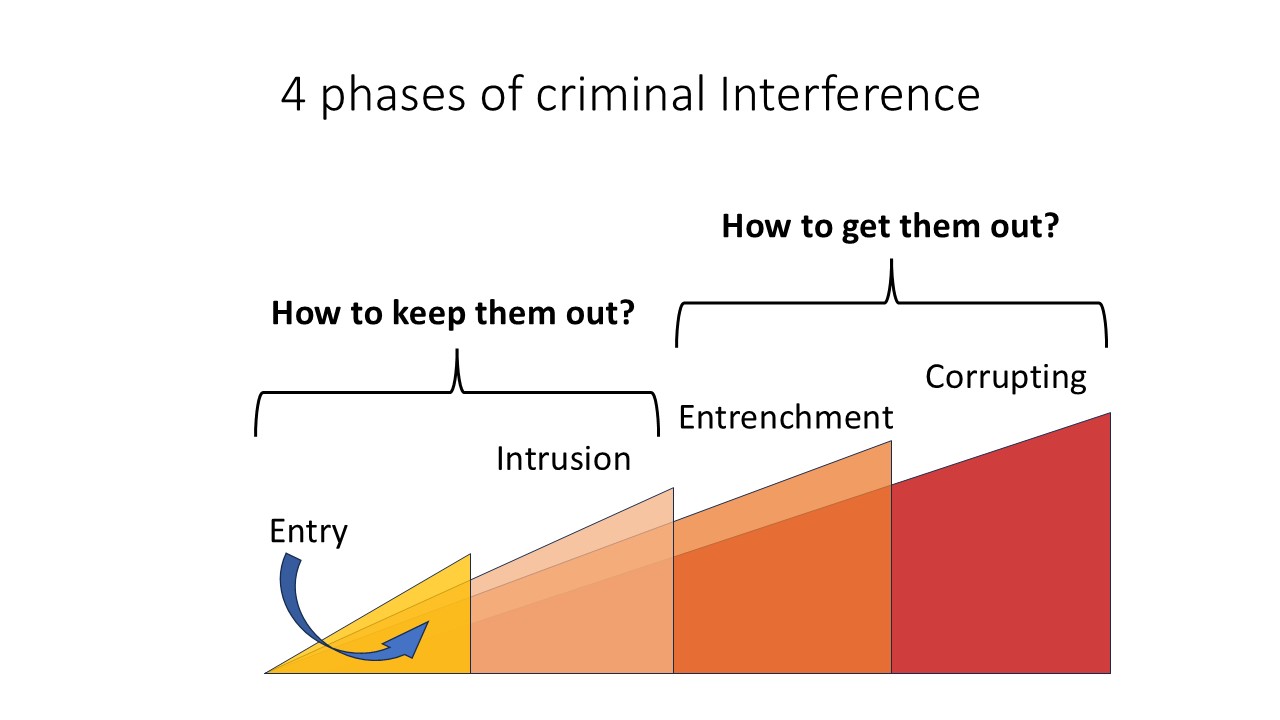
Criminal interference can ultimately have serious consequences for a company’s survival. We distinguish four stages of criminal interference: Entry, Intrusion, Entrenchment and Corrupting.

In the first two stages, which occur most frequently, the emphasis is on developing responsiveness with a view to prevention. The aim is to keep criminal influences outside the organisation as far as possible, while also preparing the organisation for the point at which interference develops further into Entrenchment. Measures and interventions focus on raising awareness and mobilising employees when signs of criminal influence emerge.

The situation changes when criminal influences become entrenched within your organisation. This is when several employees begin carrying out instructions from criminals and a criminal subculture develops within the organisation. Or worse still, when the company’s performance is affected by the corruption of several employees.

The aim of resilience against Entrenchment and Corruption is to develop an organisation’s responsiveness both towards external threats and towards criminal subcultures within the organisation itself. In these final two stages of criminal interference, it is important to actively involve and mobilise trustworthy employees who act with integrity.

In cases of corruption, cooperation with the police and criminal justice authorities is essential. Criminal offences then provide grounds for removing corrupt employees from the organisation.

We will first examine what happens when criminals gain Entry to your organisation or what will be signs of Intrusion. We then explain what management should do at these stages.

Criminals gain Entry to your organisation: what does it look like?

Because criminal influence most commonly occurs at operational level, this is where the article focuses. Where relevant, we also briefly consider criminal interference at higher organisational levels.

The problem is that, as an entrepreneur or director of a public organisation, you will usually only notice criminal interference at operational level once it has already been going on for some time. After all, criminal intentions and prohibited behaviour are things people generally want to keep hidden. If you wait until the signs of criminal interference are completely obvious, you are already on the back foot.

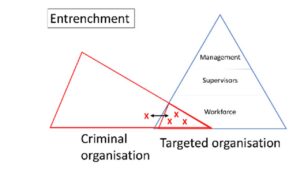
The adjacent figure illustrates what may happen. The blue triangle represents a legitimate organisation. It could be a business, a public organisation, sports club or care institution. The red, skewed triangle represents a criminal organisation. The red X represents a criminal, while the black X represents someone who pays little attention to the dangers of criminal interference.
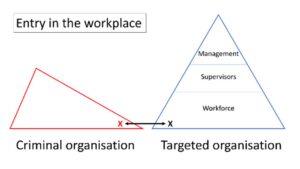
Entry is a first meaningful contact. There is a criminal intention behind making that contact. The approach may be friendly and non-intrusive. It often appears entirely innocent. People meet one another, after all. Entry into your organisation may be established through a vulnerable employee struggling with addiction, someone who has recently lost a loved one and is receptive to sympathetic contact, or an employee who has gone through a divorce and is struggling financially.

Within a school, it might be a pupil who receives a friendly message, followed by an enjoyable chat. Or consider a driver working for a transport company who regularly drives to other European countries and suddenly receives an envelope containing several hundred euros. Inside is a card congratulating his wife on her birthday, together with a telephone number to call.

Criminals can also gain Entry at a higher organisational level. For example, an accountancy firm is experiencing severe financial difficulties. The director is losing sleep over it. Several invoices have not been paid because customers are experiencing payment problems, while the firm’s staff and premises costs continue. A business acquaintance offers to help by providing an interest-free loan, provided the director keeps the accounts of one of his companies ‘discreetly’.

Another example of Entry at a higher organisational level: a work van belonging to an installation company is stolen during the night. The vehicle, tools and materials are quickly worth more than €100,000, quite apart from the lost income if the company cannot work. The entrepreneur is unsure whether to report the theft. It will take a great deal of time and there is no guarantee that the van will ever be recovered. He therefore contacts the director of a company across the road. He knows that this person has contacts in the criminal world. The following day, the work van is back in its usual parking space.

The entrepreneur has not committed an offence, but by taking this route he has nevertheless created an Entry point for future favours, which may be difficult to refuse.

Examples of Intrusion
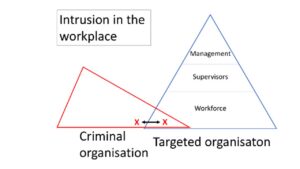
Intrusion occurs when an individual employee repeatedly facilitates criminal practices or commits such acts themselves. When more people are involved, we have moved into the next stage: Entrenchment.

Intrusion can take three forms: misuse of business processes, recruitment of an employee, and infiltration by a member of a criminal organisation.

Misuse of business processes is particularly common in transport because drugs only acquire market value once they have been transported to customers. For example, the transport function of an international fruit trader is secretly misused to transport cocaine abroad. The fruit serves as a cover load. But the drugs have to be removed somewhere, and someone within the organisation must provide the opportunity to do so.

Intrusion can also involve recruiting an employee. A driver for an international transport company is asked to take a package with him and deliver it to acquaintances somewhere along his route. The excuse given is that it contains Dutch products that are unavailable in that country.

A lawyer receives what appears to be a reasonable request from a criminal in custody whom he is defending. He is asked to send a birthday card to the man’s young son, unaware that this is part of a code language that has a completely different meaning within the criminal enterprise.

A favour may be requested again. Saying no is not easy. It could damage the pleasant relationship. The repeated favours may also be rewarded: money, a ticket to a football match or an all-expenses-paid holiday. This encourages the employee to do it again.

Intrusion then becomes structural. The parasitic criminal organisation increasingly benefits from valuable assets and resources offered by the targeted organisation. If the employee refuses to cooperate, the relationship may change. Because the earlier favours were generously rewarded, more is now demanded. What began as a friendly relationship turns into one involving pressure and intimidation.

Previous cooperation in criminal activities can be used as leverage. Disclosure could be damaging to the employee and might cost them their job. In this way, the recruited employee becomes part of the criminal organisation.

The third form of Intrusion is infiltration. A local authority employs an intern in its finance department. It turns out that he changes the bank account number on invoices, diverting payments into the banking network of a criminal organisation.

Sometimes infiltration occurs higher up in the organisation. A manager responsible for the administrative and financial department of a utility company uses criminals’ money to have a back door built into the digital subscription system. This allows fictitious subscribers to be created and, on the basis of fabricated circumstances, refunds to be made to them. The diverted money is divided between the criminals and the head of department.

This gives a criminal organisation a permanent foothold within the organisation. If necessary, this position of influence can later be used, for example, to recruit employees from the department. The head of department also makes himself vulnerable to blackmail.

Assessing your own vulnerability

The deployment of interventions should be risk-based. Preventing Entry and Intrusion therefore begins with an assessment of your organisation’s own vulnerability.

The Handreiking Kwetsbare Branches (Guidance on Vulnerable Sectors) published in 2024 identifies several economic sectors as vulnerable: Transport & Logistics, Property & Estate Agency, Hospitality, Horticulture and Retail. News reports show that public organisations are also affected by criminal interference, including local authorities, the Tax and Customs Administration, courts, Customs and care institutions.

In recent years there have also been numerous reports of information systems being hacked at public bodies (the Judicial ICT Organisation, Ministry of Finance, Dutch Data Protection Authority and Council for the Judiciary) and companies (Booking.com, De Bijenkorf, ING, Ace & Tate, Bol.com, Ajax and Odido).

To assess your own vulnerability, look at three aspects:

1. Attractiveness

Does your company operate in one of the vulnerable sectors mentioned above? Which parts of your business processes are attractive to criminals (transport, storage, information or financial infrastructure)?

2. Accessibility

Misuse of business processes is easier when unauthorised people can easily gain access to company premises or buildings.

Recruiting employees is also easier when an employee is struggling with debt, addiction or loneliness. Criminals can exploit these circumstances and try to win people over. The likelihood is also greater when there is little social control in the workplace. This may be the case, for example, when employees work largely independently and at customers’ premises.

Working with large numbers of agency or contract workers can also reduce social control. This applies particularly when some of those workers do not have a good command of English (or Dutch in the context of The Netherlands).

An organisation may also be more vulnerable to infiltration if little attention is paid to potential infiltration risks during recruitment. Staff shortages can play a role here as well. Pressure to recruit new employees quickly may then outweigh attention to the potential risks of criminal infiltration.

3. Responsiveness

An organisation becomes vulnerable when it is insufficiently capable of responding to signs or suspicions of criminal interference. If employees do not know what the warning signs are, how to recognise them or what they should report, the organisation will find it difficult to act. The same applies when it is unclear where employees should take a concern or suspicion and what happens after they report it.

Organisational culture also plays an important role. If employees do not challenge one another’s behaviour, criminal interference can remain undetected more easily. The same applies when drug use occurs within the organisation and dealing in drugs is therefore less readily regarded as problematic. In such circumstances, the threshold for reporting something may be higher.

Cultural resilience is also weakened when dishonest behaviour occurs repeatedly without consequences. If employees gain personal benefits from unethical behaviour, for example, the threshold for seeking financial gain through criminal interference may also become lower.

All of this leads to the central question: Is my organisation vulnerable? If it is, action is required.

Building responsiveness

An organisation should not wait until a warning or report of criminal interference has been received before developing its responsiveness. Precisely when criminals first make contact with an organisation, or may already have penetrated it, the organisation needs to know how to respond.

Building responsiveness should therefore be based on an assessment of the organisation’s vulnerability, rather than beginning only in response to one or more concrete reports.

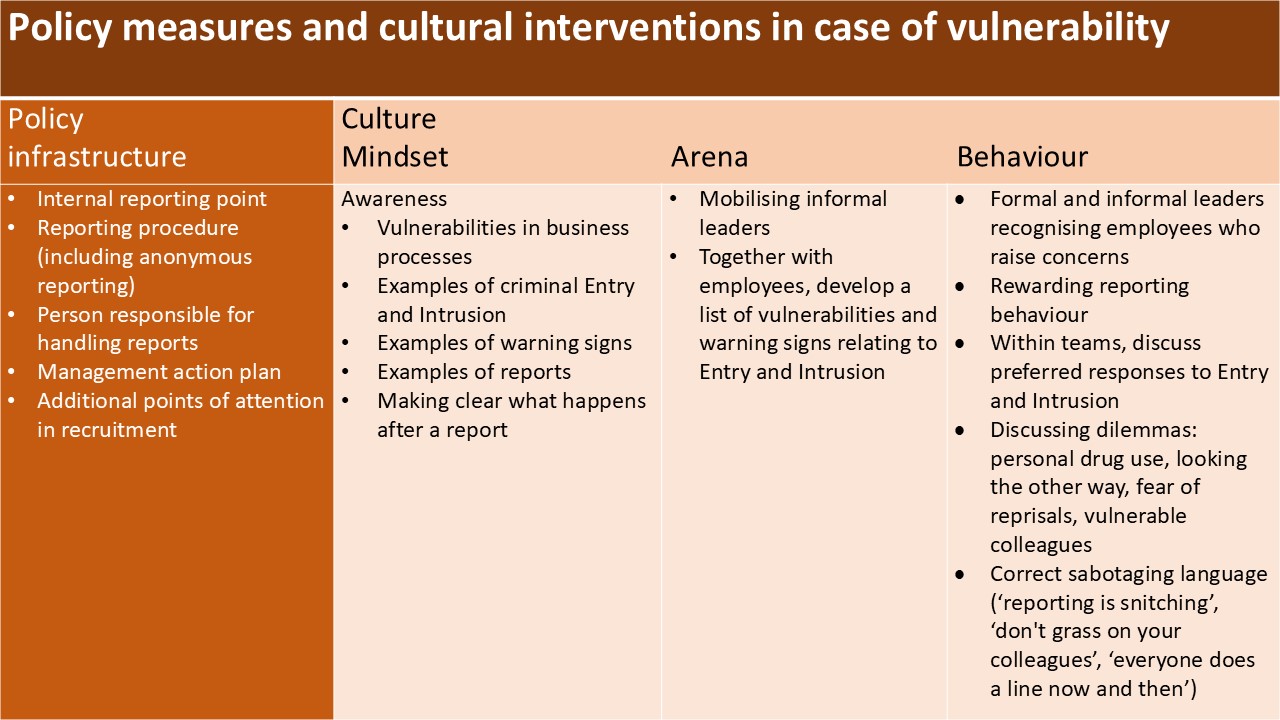
Two sides of the organisation are important here: the policy infrastructure and the culture.

The policy infrastructure consists of strategy, objectives, organisational structure and business processes. Culture concerns the human side of the organisation: how employees interact, which norms and values they apply and which behaviour they regard as normal. Culture therefore gives practical expression to policy. Two organisations may have comparable structures and working methods on paper, yet function very differently because their cultures differ.

Policy infrastructure and culture need to complement one another. Infrastructure measures create the conditions for an organisational culture that produces the desired behaviour: detecting signals, responding, reporting, cooperation between managers and the operational workforce, and mutual social control.

A management decision to establish a reporting point is not enough to create a reporting culture. Introducing additional points of attention into recruitment procedures does not mean that these points will consistently receive attention.

An organisational culture consists of three elements: behavioural repertoire (the solutions people commonly use); mindset (shared beliefs that justify behaviour); and arena (the formal and informal relationships of influence within teams and departments, together with unwritten rules).

Protecting the organisation against the first stages of criminal interference therefore means introducing changes on both the infrastructural and cultural sides. Policy measures provide the foundation. Mindset interventions focus on awareness. If you do not know what to look for, you will not see the warning signs. Arena interventions are important for making resilience the norm within teams. Behavioural reinforcement encourages desirable behaviour.

The combination of policy measures and cultural interventions should ensure that the organisation becomes better able to respond to criminal influence. That is the objective of resilience during these first two stages of criminal interference.

The aim is not to introduce as many measures as possible, but to develop a realistic approach in which different measures reinforce one another and collectively contribute to the desired outcome.

For example, after receiving instructions on the reporting procedure, informal team leaders may set the right example by making a report themselves. This makes it easier for other employees to do the same. If formal and informal leaders subsequently respond positively to reports and recognise this behaviour, the threshold for reporting the next time becomes lower.

The same applies when teams are encouraged to think for themselves about the best way to respond when they encounter signs of criminal interference. This creates not only knowledge about what to do, but also a shared understanding of desired behaviour.

The response of senior management is equally important. If management actually follows the previously agreed action plan after a report is made, employees see that reports are taken seriously. This strengthens trust and makes clear that the organisation genuinely regards safety and resilience as important.

A good approach also ensures that employees know what next step they can take when a situation requires it. An unusual or suspicious request from a customer, for example, may be a reason to consult a manager immediately. The employee on the frontline is then supported and does not have to decide alone how to deal with a potential risk.

This strengthens the organisation’s responsiveness as a whole because the different levels of the organisation are connected.

By thinking in advance about how measures and interventions can reinforce one another, greater impact can be achieved with less effort. It is therefore not about more measures, but about measures that fit together and strengthen one another. The important question is whether the intervention mix being used is sufficient to achieve an adequate level of responsiveness.

The following examples illustrate what collective responsiveness can look like following the implementation of a chosen intervention mix:

  • A customer of a textile company refuses to explain to a sales employee what certain fabrics are intended for. The sale does not go ahead because the fabrics could be used to manufacture bullet-proof vests.
  • A customer of a self-storage company wants to rent several units for a year and pay the full amount in cash up front. The rental agreement is cancelled because the company does not accept cash payments.
  • A printing company produces, among other things, ‘pony packs’: small paper envelopes featuring a rearing horse. The company does not sell more than an internally agreed quantity because the envelopes are used to package individual quantities of cocaine.
  • A dubious customer is turned away by the sales department by extending the delivery time for the requested products and substantially increasing the price of bespoke products.

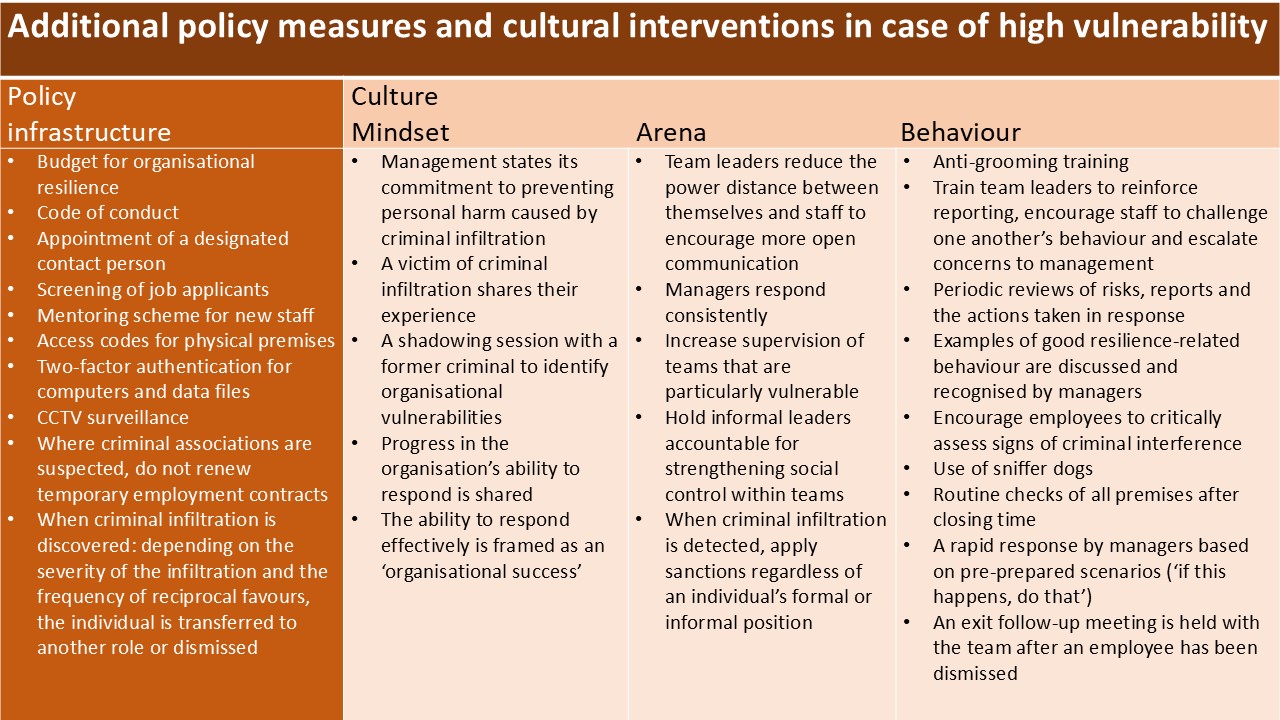
What more can you do when vulnerability is assessed as high?

If the organisation operates in a highly vulnerable sector, if it becomes clear that criminals have penetrated similar organisations in the region, or if there are indications that Intrusion is occurring within the organisation itself, more robust measures and interventions are needed to keep criminal influence out.

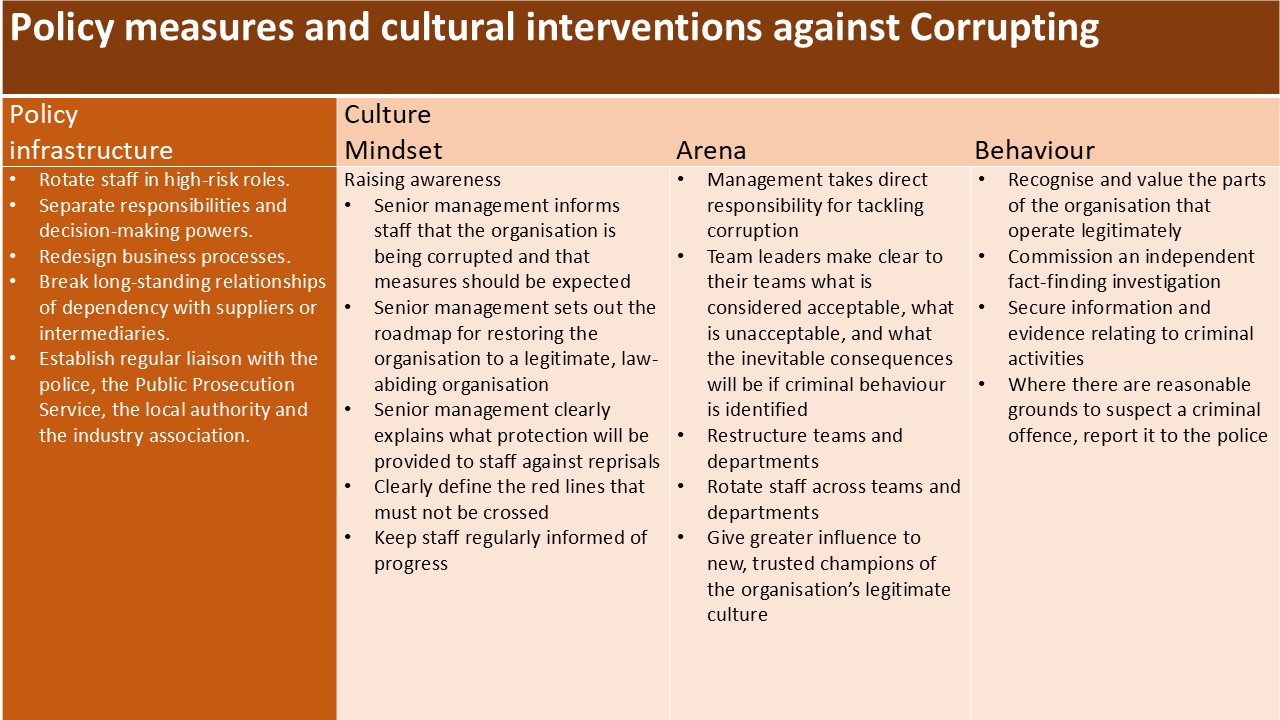
The following matrix provides an overview of possible interventions.

The resilience objective remains the same. The aim is to establish adequate responsiveness within the organisation. The intervention mix is different because the risks of Intrusion are assessed as higher.

Desired behaviour is particularly strengthened when informal leaders and team leaders actively and positively reinforce it within their teams. When management, team leaders and employees on the frontline know what is expected of them and respond in broadly consistent ways, the organisation as a whole becomes better able to act. This is an important characteristic of responsiveness.

Good responsiveness strengthens cooperation and cohesion within the organisation. Employees experience greater trust and pride because they see that the organisation is capable of dealing with risks. This also changes the way employees perceive potentially risky situations: fear decreases and confidence in taking action increases.

Resilient behaviour therefore becomes more natural, and employees develop new ways of dealing with risks and signs of criminal interference.

In this way, responsiveness can ultimately contribute to an organisational culture that is better suited to an environment where the risk of criminal inteference is greater.

Entrenchment: undermining organisational culture

In the Entrenchment phase, a transactional relationship develops between a criminal organisation’s contact person and several employees of the affected organisation. The criminal contact has power over these employees and gives them instructions. The corrupt employees have therefore become part of the informally organised criminal network.

Examples include a sales employee at an international company who smuggles money abroad for criminals, while someone in the internal sales department arranges the trip and ensures that the money can be left at various addresses. Another example is several lorry drivers who transport cocaine in a hidden compartment of their vehicles during their regular deliveries.

For the criminal contact, it is difficult to ensure that recruited drivers keep their activities secret, particularly when a fixed pattern develops. Fellow drivers may notice something suspicious and be persuaded to participate as well, generating additional income for themselves.

Criminal behaviour then spreads, and so does the cultural influence. Cultural characteristics associated with criminal organisations become visible in the affected company. Secrecy, opportunism, intimidation and reprisals against those who fail to comply with agreements are characteristic of the increased influence of criminals.

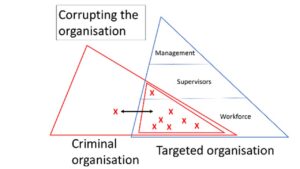
Entrenchment can easily lead corrupt employees to form their own subculture, represented here as a red, skewed triangle within the affected legitimate company, shown as a blue triangle. This closed group functions as a hidden and isolated criminal subculture within the organisation. It is hidden and isolated because criminal practices must remain secret.

Ways of thinking and behaving that are common within the criminal organisation are adopted by the group of drivers. This mindset and behavioural repertoire can then infect other colleagues. The subculture can develop into an informal organisation with its own objectives, informal hierarchy, division of tasks and communication channels. For example, an informal criminal leader may create a closed messaging group in which information is exchanged about lucrative illegal loads or tips on how to justify deviations from planned routes.

Such a subculture can influence the company’s overall culture because others become infected by it. Cultural damage occurs when colleagues or even managers know about the criminal practices but look the other way. They report nothing for fear of what might happen to them.

A culture of fear develops. Criminal interests begin to compete with the interests of the company. Management authority consequently declines. Cooperation between employees comes under pressure because of unspoken secrets and a loss of trust in loyalty to the company.

Because criminal behaviour occurs regularly among several employees, there is a strong likelihood that warning signs will become visible. The box below uses the transport sector as an example. The signs listed also apply to companies in other sectors with a transport function.

Platform Veilig Ondernemen (Platform Safe Entrepreneurship) has compiled a list of signs that may indicate Entrenchment:

  • Drivers suddenly buying expensive items
  • Planners who appear inexplicably nervous
  • An opening in the outer fence or objects such as bags or boxes along the fence
  • A container found in an unusual location
  • A damaged container (broken floor, wall or ceiling)
  • A container seal missing or incorrect
  • The load does not match expectations: very ripe fruit, or fish or meat that has not been refrigerated
  • Damaged or unusual packaging of goods
  • A stranger asking for a container to be moved to another location
  • A stranger asking about the loading or unloading location or a container number
  • Vehicles that do not belong on the premises
  • Lorries being loaded or unloaded at unusual times
  • A passenger car parked very close to a lorry
  • Your lorry being followed while on the road

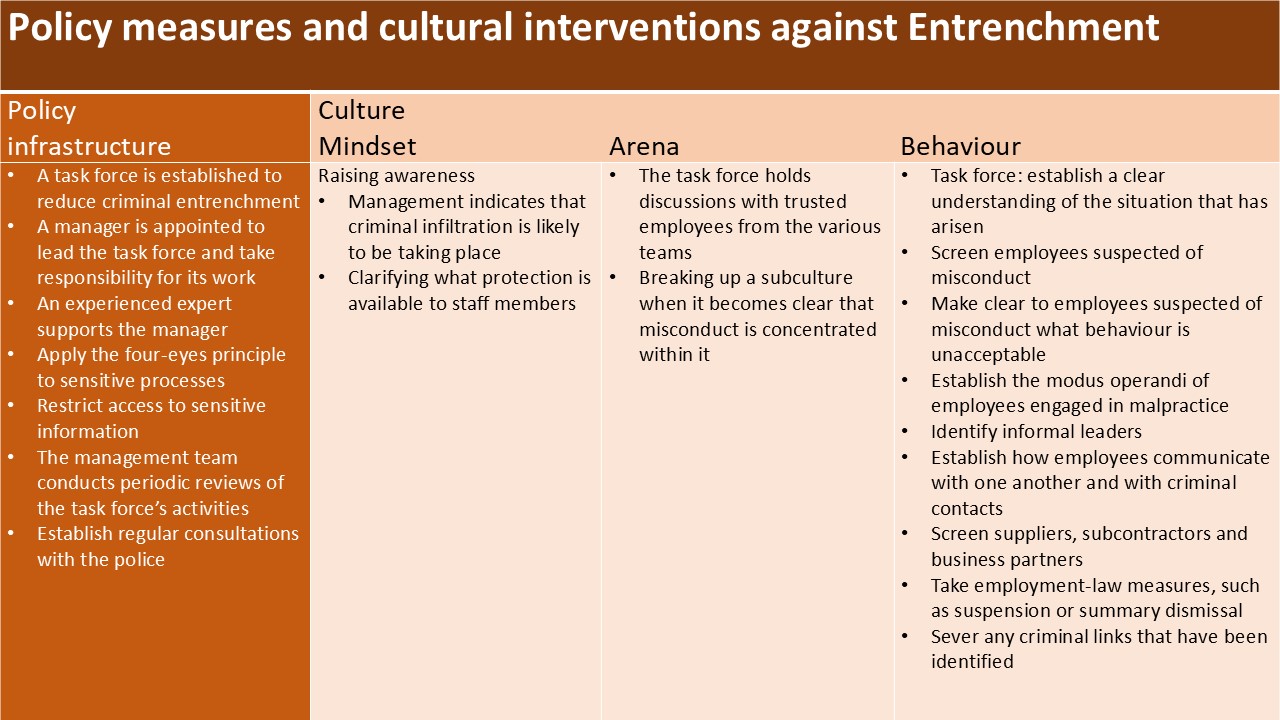
Cultural interventions against Entrenchment: how do you drive the criminal subculture out?

If there is a suspicion that several employees are under the influence of criminals, and certainly if this is confirmed by reported warning signs, a different resilience strategy is required from that used during the first two stages of criminal interference.

The criminals are already inside. The main objectives in further developing responsiveness are now to:

  • identify who is involved in the group;
  • establish how far the group’s organisation has developed;
  • identify the informal leaders within the group;
  • break up the group;
  • remove criminal employees from the organisation;
  • protect legitimate employees.

The measures and cultural interventions below have been developed for the transport sector as an example.

The responsiveness developed during the earlier stages must now be directed towards internal relationships. Achieving this requires coordinated action by a group of trusted people.

The organisation should assemble a group of employees and managers whom management knows to be uninvolved in criminal practices and not influenced by criminal outsiders. This group will act as the eyes and ears of the manager responsible for driving the criminal subculture out of the organisation.

When Entrenchment occurs, it is important to involve expertise from the relevant industry association, and, where appropriate, a consultant with experience in this field.

Corrupting the organisation as a whole

Once several parts of the organisation have become contaminated following the Entrenchment phase, not only is the organisational culture weakened, but the organisation itself is also affected.

This can threaten the survival of an affected company or public institution.

For example, a company’s transport function may be repeatedly misused to transport drugs, people or money. The finance department may be used to launder money. People leave the company. The organisation’s reputation is damaged. The company drifts into the criminal milieu.

Criminal suppliers and customers become part of the business environment. Fear begins to determine how people within the organisation act and interact.

Because the targeted organisation increasingly takes on characteristics of a criminal organisation, we represent it in the figure above as a skewed triangle. The red skewed triangle within the company or public institution now makes up a larger part of the organisation. At the same time, it forms part of the criminal organisation.

Supervisors are now likely to be part of this criminal subculture as well. They either participate themselves or know what is happening but take no action against the criminal influence.

The Port of Rotterdam provides a good example of how corruption within an organisation can be exploited by criminals. Within Dutch Customs, the Pre-arrival department plays an important role. This department determines which incoming containers should undergo further inspection, for example using a container scanner. Employees can therefore determine which containers receive additional scrutiny and thereby influence the likelihood of drugs being intercepted.

This makes the department vulnerable to criminal recruitment. In the past, several customs officers have been convicted of allowing containers containing drugs to pass through. More recently, according to the Public Prosecution Service, there have also been indications that customs officers have been bribed.

Measures and cultural interventions against Corruption

Using the example of the customs officers, we show which measures and cultural interventions can be taken.

The aim is to scale up responsiveness to a broader network of cooperation. This involves not only the company itself, but also the police, the Regional Information and Expertise Centre (RIEC), the Public Prosecution Service and the relevant industry association. It is important to establish a clear division of responsibilities. What does the company do itself, and what role will the police, Public Prosecution Service and local authority play?

A resilient organisation begins with resilient employees

Criminal interference often starts small but can develop step by step from an initial contact into a situation in which the organisation itself is undermined. Waiting for hard evidence is therefore not a strategy. Resilience requires early insight into vulnerabilities, the development of a culture in which employees recognise and report warning signs, managers who respond consistently, and an organisation that acts when more robust measures are required.

It is precisely the interaction between creating the right conditions through the policy infrastructure and implementing coherent cultural interventions in the areas of mindset, arena and behaviour that makes it possible to keep criminal influence outside the organisation and, if it is already inside, to push it back. The ultimate aim is not to create an organisation that can eliminate every risk, but one that develops the capacity to recognise risks in time, act collectively and protect its own values and interests. That is what resilience means.

If a pincer movement can be created between what organisations do themselves and the repressive measures taken by the criminal justice system, this will reduce the space available to the criminal shadow economy. Evaluations can lead to approaches that can also be used in other areas of society, such as residential neighbourhoods and schools, to reduce criminal interference.