
Theme #3 Criminal interference

Between roses and routes: how criminals hitch a ride on the Dutch flower trade

Rita van Dijk en Alex Straathof in conversation with Bas van Delden, October 2026

It’s early morning at a flower auction somewhere in the western Netherlands. Trolleys full of roses, tulips and orchids move through the halls in what looks like a perfectly oiled choreography. Drivers load lorries, traders make calls, boxes slide from cold store to dock. Everything runs on speed, precision and freshness.

But somewhere within that tight routine is a worker taking an atypical route. An unmarked van is parked in an odd spot. Someone is on the shop floor despite not being on shift. Small deviations in a system that is organised so tightly, and precisely for that reason, so vulnerable.

Because Dutch floriculture, with an export value of €12.3 billion in 2025, isn’t just a logistical marvel. It also offers an ideal infrastructure for criminals. While awareness of this vulnerability took hold long ago at the Port of Rotterdam and Schiphol Airport, in this sector that realisation has only really gained ground in the past few years.

A logistical paradise, for criminals too

Dutch floriculture is a global logistics powerhouse. Flowers cut yesterday in Kenya or Colombia can be standing in a vase in Paris or Berlin tomorrow. That speed and reliability rest on a fine-meshed network of auctions, distribution centres and thousands of daily transport movements. It’s precisely that efficiency that makes the sector attractive to criminals.

The report Mainport in de tweede linie: Over sierteelt en ondermijning (2021) (Mainport in the Second Line: Flower Trade and Undermining) goes into detail on the opportunities floriculture offers criminals. This also came up in our interview with Bas van Delden, who until early 2026 was programme manager of the Resilient Floriculture programme. We spoke with him about the role of the shop floor, the signals that should put you on alert, and what the industry itself can do.

The opportunities for criminals are clear. The Mainport in the Second Line report sums them up as a combination of close links to Schiphol and the Port of Rotterdam, almost unrestricted freight movement within Europe, and fixed transport flows that make nearly every destination reachable quickly and predictably.

The way the sector is structured only adds to its vulnerability to criminal interference. The trade chain has many links, transactions and points of transport, leaving little overall oversight. The growth of direct trade outside the auction system creates extra room for fraud, cash payments and abuse. Small businesses under financial pressure are especially exposed.

The general infrastructure is also strikingly open: anyone can drive onto an auction site unimpeded. Bas van Delden confirms this. The sites are often freely accessible, he says. ‘Few fences, few checks, little social correction from colleagues. You can walk around almost anywhere.’

Flowers are also transported in open boxes, making it relatively easy to add illegal goods to shipments, or remove them, without drawing attention. The hundreds of loading docks are hard to monitor. Companies also let others onto the premises, and activity can easily be kept out of sight. Flowers are prepared for transport at the docks — a convenient moment to hide drugs or other contraband in a shipment. Locked offices with safes are used for both legitimate and illegitimate transactions.

Because flowers are perishable and the trade carries such economic weight, checks and oversight at Europe’s internal borders are limited. ‘They’re not opened as a matter of course’, says Van Delden. ‘Only on a spot-check basis, at hubs like the ports or Schiphol. Opening a container immediately damages the shelf life. Inspectors are cautious because of possible damage claims and lost time. Once you’re past customs in the trading process, your chance of getting caught is fairly low.’

On top of this, the sector is naturally closed off. Willingness to report is low and contact with the authorities minimal. The industry is strongly oriented towards solving problems internally. A culture that is deeply rooted in family businesses. Signs of fraud, exploitation and smuggling therefore stay under the radar for a long time, while government presence and visibility in the sector and on its premises have long been limited.

How big is the problem?

Given the opportunities the industry offers, you might expect a clear picture of how deeply crime has penetrated floriculture. That picture is missing, not without reason. The report Mainport in the Second Line notes that information on crime in the flower and plant trade is fragmented: local or regional authorities often don’t learn from found contraband or uncovered fraud abroad. Fraud, labour exploitation, scams and cigarette smuggling are, moreover, well concealed, so they rarely make the statistics. The result: the criminal opportunities are better documented than the criminal practices themselves.

Hard cases do exist but remain limited to a handful of major ones. A flower wholesaler in the Westland has been suspected since 2026 of large-scale money laundering, with €300,000 in cash reportedly coming in each week. It’s precisely that lack of insight into the scale of criminal involvement that has had major consequences: the Resilient Floriculture programme therefore focused primarily on building support for the idea that a problem exists at all.
‘As a criminal, you often don't need the director at all’

The workplace as the weak spot

Anyone who pictures criminal infiltration mainly on the level of company directors is, according to Bas van Delden, looking in the wrong direction. In floriculture, the weak points lie not so much at the top, but far more on the workplace.

‘As a criminal, you often don’t need the director at all’, says Van Delden. ‘If you have access to logistics, including loading, unloading and planning, you’re already a long way there’. Criminal networks don’t operate by taking over the system, but by blending into it. Flowers, drugs, money and transport are combined into a single stream. That requires knowledge of the sector, but no visible position of power.

Once flowers leave the site, much of the process moves beyond the reach of monitoring. The drivers who collect the cargo are hired by the buyer. ‘You see every variation’, says Van Delden. ‘Regular drivers on fixed contracts. And at the other extreme: a freelance driver from Central Europe who signs up via a website for a random load. You often don’t know who’s going to show up. A driver arrives with a code and a slip and picks up a load. It’s already waiting and goes into that lorry.’

Small deviations, big signal

Crime in floriculture is rarely spectacularly visible. It’s in the details. Small deviations in an otherwise tightly organised process. ‘A box of roses is normally light’, Van Delden explains. ‘If you hide cocaine in the box, it gets a lot heavier. If you suddenly see people carrying a box like that as if they’re straining under the weight, something’s off. But if you don’t know the process, you won’t notice anything strange.’

Another example: flowers always belong in refrigeration. Cold store to cold store, without exception. ‘If you see a box standing outside the cold store and nobody can explain why, that’s odd. Or on camera footage you see people taking atypical routes. The flowers are heading the wrong way.’ Then there are the subtler signals: someone who never takes time off, a car parked in the middle of the lorries, staff present outside their shift. Night-time activity on site, unfamiliar vehicles, docks being screened off before loading and unloading even begins.

‘Those deviations don’t necessarily mean anything on their own’, Van Delden stresses. ‘But they should make you alert and prompt you to take a closer look and ask questions.’

Why employees get involved

Behind every case of criminal interference lies a human story. Without someone on the inside, successful drug trafficking is virtually impossible, but such involvement can arise in very different ways.

‘If you refuse, it turns out they know which school your children go to’

‘You have people who never intended to get involved but who are dealing with serious debt problems’, says Van Delden. ‘That makes one vulnerable, because criminals also notice when someone isn’t doing well. You have people with no debts or problems at all who simply give in to the temptation of quick money. You have people who are threatened: one evening, you find some criminals waiting for you. They tell you they want you to do something for them. If you refuse, it turns out they know which school your children go to. And then you think: I never meant to do this, but I’ll do it anyway. And finally, there are people deliberately planted by a criminal organisation. They land in a role and work their way up. That’s highly deliberate.’

Structural vulnerabilities reinforce this: the use of cheap, flexible labour, temporary contracts, migrant workers with limited ties to the company, and financial pressure on small businesses.

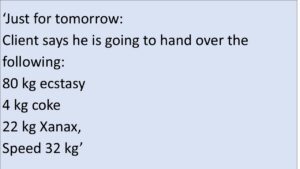
The silence of bystanders has its own logic too. Security footage shows colleagues noticing irregularities but doing nothing. Fear was initially assumed to be the main reason. But the reality proved more complex: people often don’t know how to report safely or aren’t sure whether management will act on it. ‘We also looked at drivers’, Van Delden adds. ‘It turns out that relatively high drug use occurs in that group. They drive fixed routes and have contacts along the way. It involves smaller quantities dropped off with drivers at various points on their route’, says Van Delden. ‘But lots of small quantities together still add up to large amounts.’

This is backed up by messages Dutch police intercepted from EncroChat and SkyECC in 2020, in which order lists are run through between parties. Journalists Bart Mos and Joris Polman, writing for the FD, included some of these exchanges in their article Coke tussen de bloemen (Coke among the flowers, 2 March 2026):

From awareness to resilience

The Resilient Floriculture programme focuses on keeping criminals out through four steps: raising awareness, spotting signals, erecting barriers, and cooperating with the authorities on incidents.

The first challenge was convincing the sector that a problem existed at all. ‘In the beginning, I mostly drank coffee’, says Van Delden. ‘You first have to earn trust.’ Businesses were wary of police and judicial involvement, fearing shutdowns or reputational damage. That view only shifted once it became clear what was really at stake. Van Delden recalls a conversation with a business owner who thought the deployment of heavily armed police was excessive. ‘I said: this involves enormous sums of money. If criminals lose a shipment of drugs, they come to collect it. This is a matter of life and death.’

Together with companies, a mix of technical and social interventions has since been developed:

  • Training management and staff to recognise warning signs
  • CCTV and automatic number plate recognition (ANPR)
  • Deployment of sniffer dogs (“A dog like that is brought in unannounced, walks around for a few minutes and sniffs everything out”)
  • A low-threshold, anonymous reporting system
  • Anti-recruitment training for staff
  • Personnel screening
  • The Logistics Sector Warning Register, a method that helps companies keep out repeat offenders
  • Internal liaison officers trained to recognise crime and know how to respond to incidents
  • Support for employees with financial problems
  • Guidance through a resilience scan and a crisis plan
  • Walk-along sessions with a former criminal who points out vulnerabilities

At major players such as Royal Flora Holland, the combination of measures proves most effective: technology that makes the site harder to access, alongside a culture in which reporting is becoming the norm. Smaller businesses tend to prefer less costly interventions. Bas van Delden: ‘One of the things that works best is dog checks. You do those at unannounced moments. You agree that with the business owner. (…) If goods are sitting in the warehouse and the dog comes in, well, you can’t get rid of them anymore, because everyone can see you running off with a box. This approach with the dog is relatively cheap and simple. It barely disrupts the production line. So far, very little has been found, which could be read as either a good sign or a bad one. But the impact is fairly significant.’

It starts with learning to see

The floriculture sector will never be entirely free of crime. The appeal is too great, the infrastructure too ideal. But the way it’s being dealt with is visibly changing. Where signals were once ignored, there’s now a growing willingness to take them seriously. ‘It starts with seeing’, says Van Delden. ‘But after that, you also have to dare to act.’

Amid the flowers and the lorries full of colour, a less visible battle is playing out. A fight for the integrity of a sector that, above all, runs on trust.