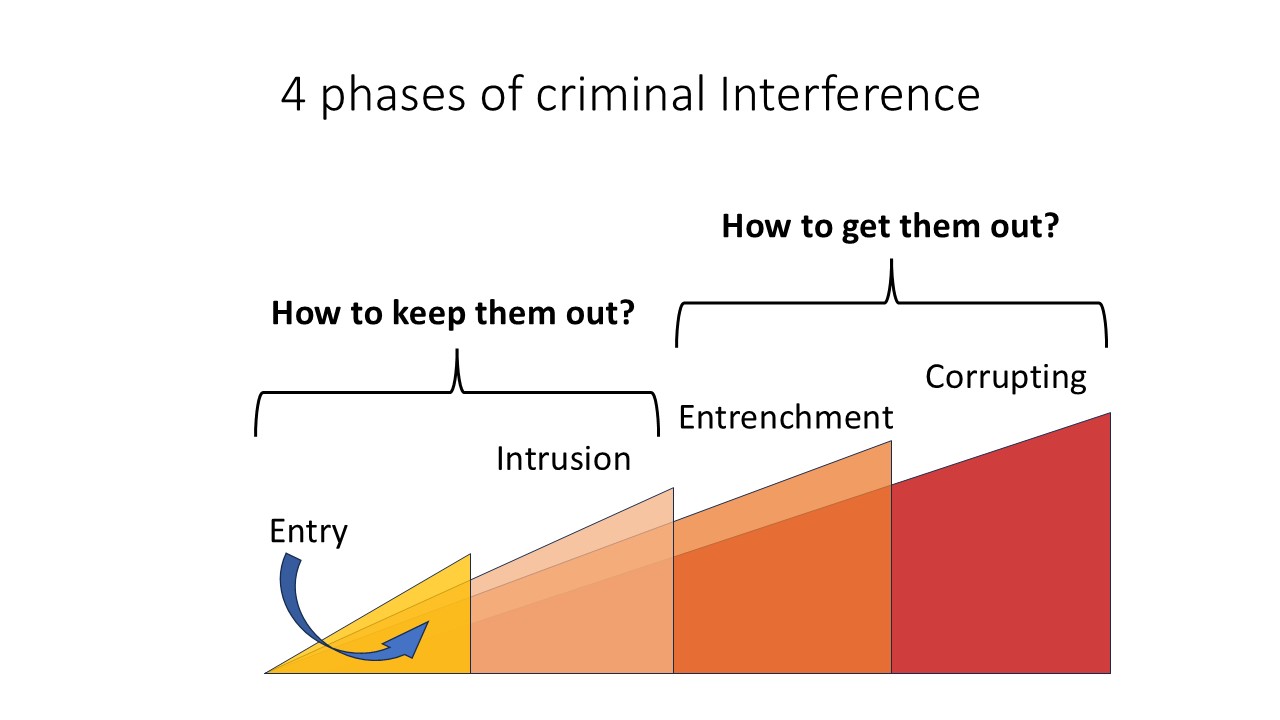
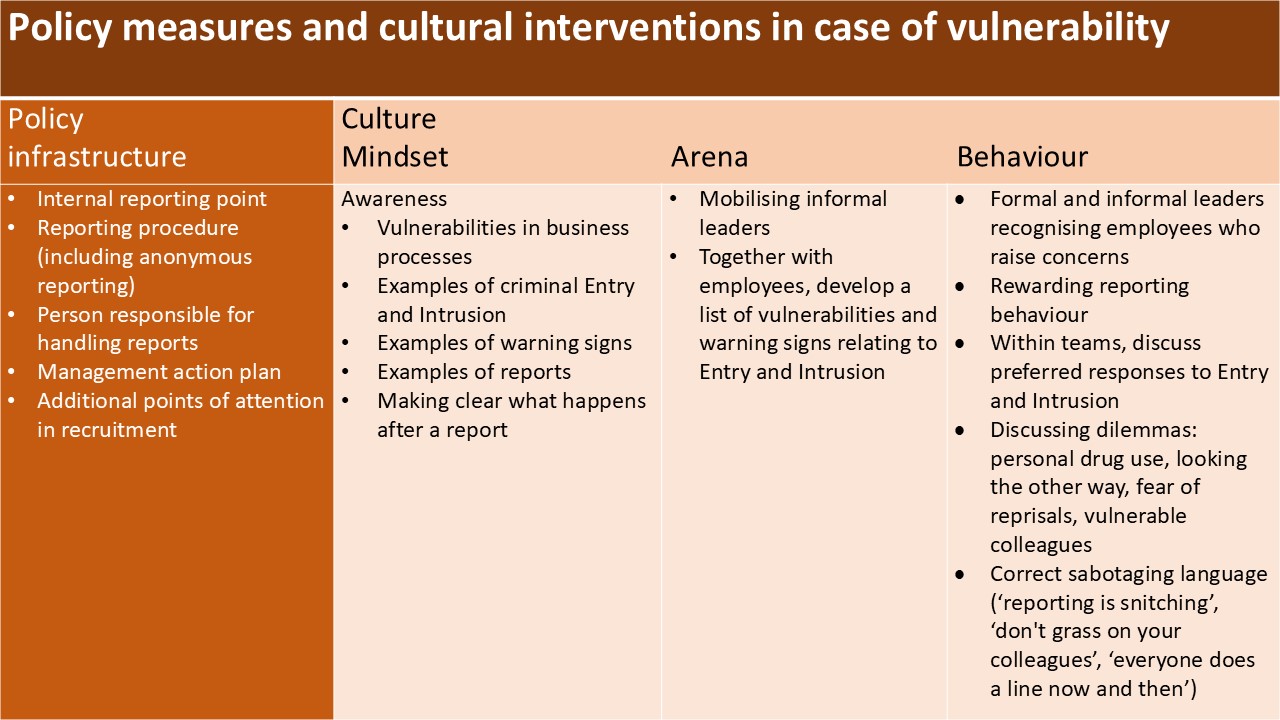
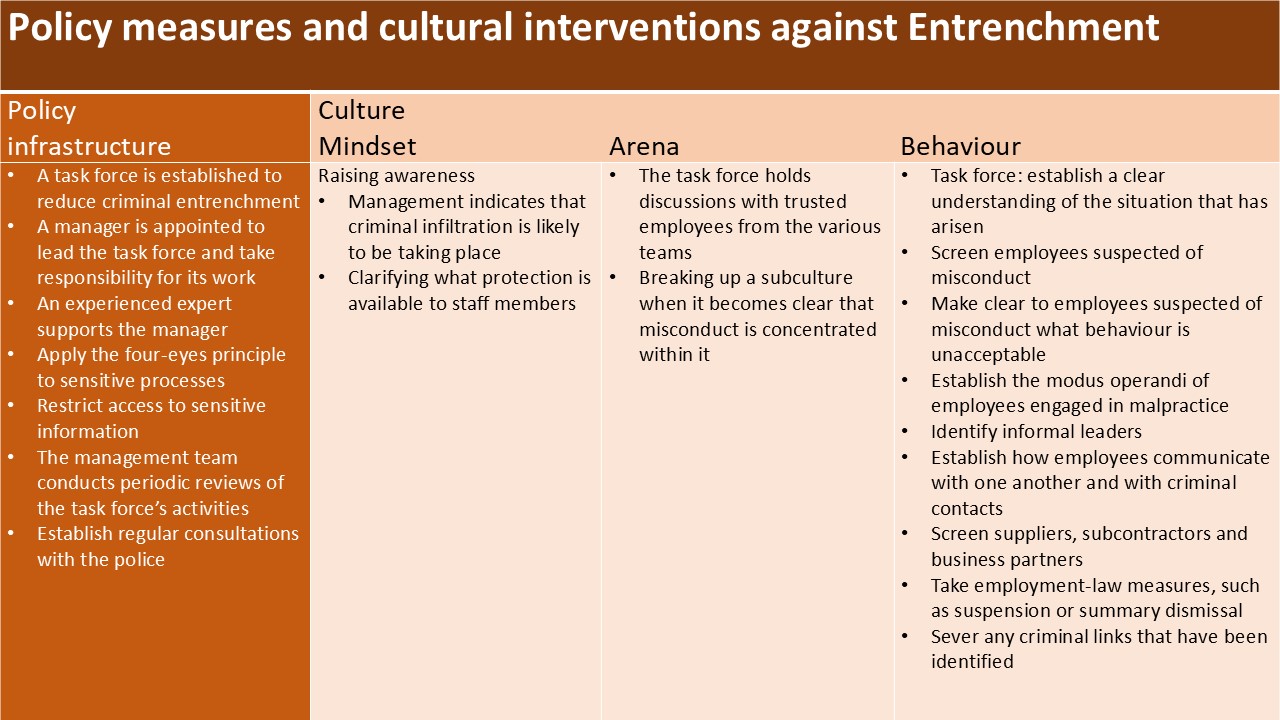
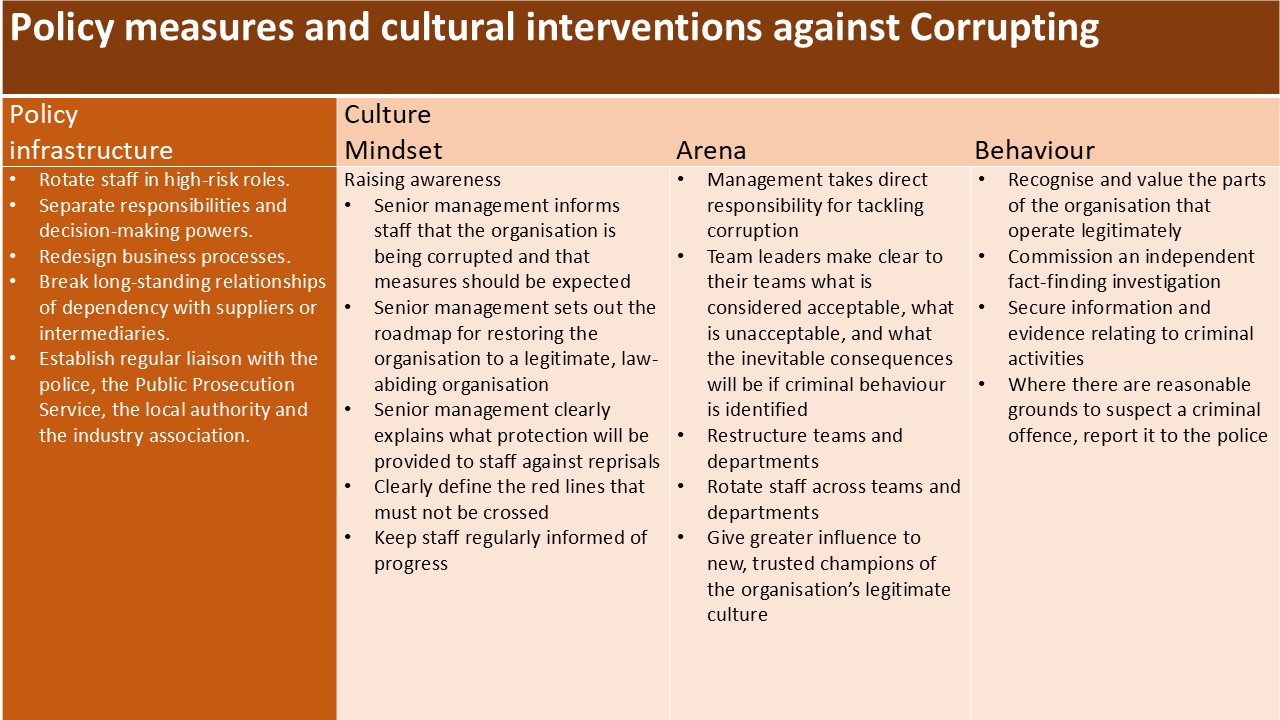
In the first two stages, which occur most frequently, the emphasis is on developing responsiveness with a view to prevention. The aim is to keep criminal influences outside the organisation as far as possible, while also preparing the organisation for the point at which interference develops further into Entrenchment. Measures and interventions focus on raising awareness and mobilising employees when signs of criminal influence emerge.
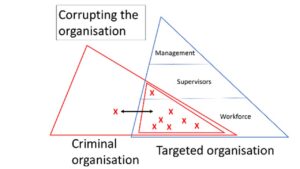
The situation changes when criminal influences become entrenched within your organisation. This is when several employees begin carrying out instructions from criminals and a criminal subculture develops within the organisation. Or worse still, when the company’s performance is affected by the corruption of several employees.
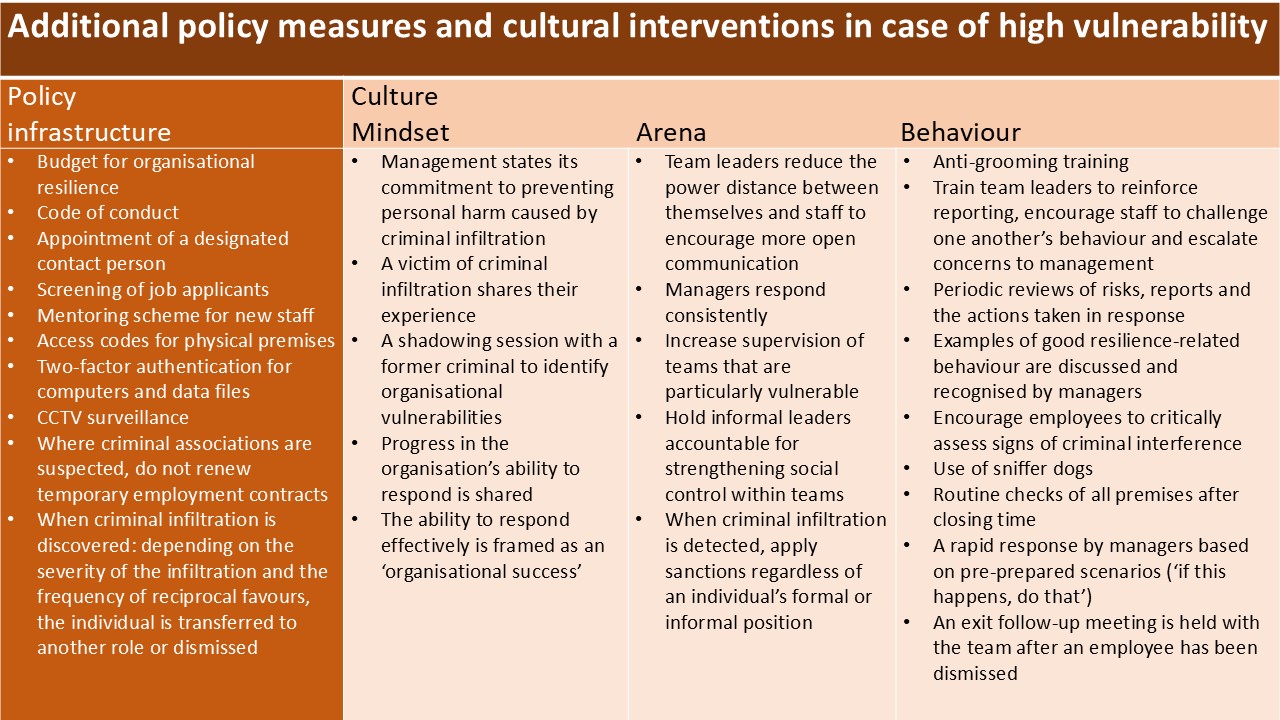
The aim of resilience against Entrenchment and Corruption is to develop an organisation’s responsiveness both towards external threats and towards criminal subcultures within the organisation itself. In these final two stages of criminal interference, it is important to actively involve and mobilise trustworthy employees who act with integrity.
In cases of corruption, cooperation with the police and criminal justice authorities is essential. Criminal offences then provide grounds for removing corrupt employees from the organisation.
We will first examine what happens when criminals gain Entry to your organisation or what will be signs of Intrusion. We then explain what management should do at these stages.
Criminals gain Entry to your organisation: what does it look like?
Because criminal influence most commonly occurs at operational level, this is where the article focuses. Where relevant, we also briefly consider criminal interference at higher organisational levels.
The problem is that, as an entrepreneur or director of a public organisation, you will usually only notice criminal interference at operational level once it has already been going on for some time. After all, criminal intentions and prohibited behaviour are things people generally want to keep hidden. If you wait until the signs of criminal interference are completely obvious, you are already on the back foot.
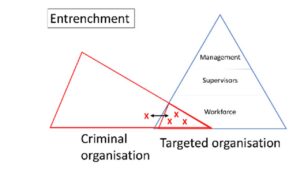
The adjacent figure illustrates what may happen. The blue triangle represents a legitimate organisation. It could be a business, a public organisation, sports club or care institution. The red, skewed triangle represents a criminal organisation. The red X represents a criminal, while the black X represents someone who pays little attention to the dangers of criminal interference.
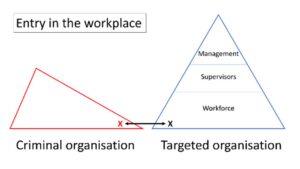
Entry is a first meaningful contact. There is a criminal intention behind making that contact. The approach may be friendly and non-intrusive. It often appears entirely innocent. People meet one another, after all. Entry into your organisation may be established through a vulnerable employee struggling with addiction, someone who has recently lost a loved one and is receptive to sympathetic contact, or an employee who has gone through a divorce and is struggling financially.
Within a school, it might be a pupil who receives a friendly message, followed by an enjoyable chat. Or consider a driver working for a transport company who regularly drives to other European countries and suddenly receives an envelope containing several hundred euros. Inside is a card congratulating his wife on her birthday, together with a telephone number to call.
Criminals can also gain Entry at a higher organisational level. For example, an accountancy firm is experiencing severe financial difficulties. The director is losing sleep over it. Several invoices have not been paid because customers are experiencing payment problems, while the firm’s staff and premises costs continue. A business acquaintance offers to help by providing an interest-free loan, provided the director keeps the accounts of one of his companies ‘discreetly’.
Another example of Entry at a higher organisational level: a work van belonging to an installation company is stolen during the night. The vehicle, tools and materials are quickly worth more than €100,000, quite apart from the lost income if the company cannot work. The entrepreneur is unsure whether to report the theft. It will take a great deal of time and there is no guarantee that the van will ever be recovered. He therefore contacts the director of a company across the road. He knows that this person has contacts in the criminal world. The following day, the work van is back in its usual parking space.
The entrepreneur has not committed an offence, but by taking this route he has nevertheless created an Entry point for future favours, which may be difficult to refuse.
Examples of Intrusion
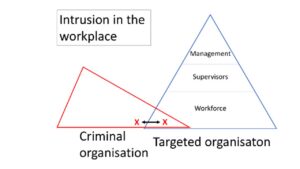
Intrusion occurs when an individual employee repeatedly facilitates criminal practices or commits such acts themselves. When more people are involved, we have moved into the next stage: Entrenchment.
Intrusion can take three forms: misuse of business processes, recruitment of an employee, and infiltration by a member of a criminal organisation.
Misuse of business processes is particularly common in transport because drugs only acquire market value once they have been transported to customers. For example, the transport function of an international fruit trader is secretly misused to transport cocaine abroad. The fruit serves as a cover load. But the drugs have to be removed somewhere, and someone within the organisation must provide the opportunity to do so.
Intrusion can also involve recruiting an employee. A driver for an international transport company is asked to take a package with him and deliver it to acquaintances somewhere along his route. The excuse given is that it contains Dutch products that are unavailable in that country.
A lawyer receives what appears to be a reasonable request from a criminal in custody whom he is defending. He is asked to send a birthday card to the man’s young son, unaware that this is part of a code language that has a completely different meaning within the criminal enterprise.
A favour may be requested again. Saying no is not easy. It could damage the pleasant relationship. The repeated favours may also be rewarded: money, a ticket to a football match or an all-expenses-paid holiday. This encourages the employee to do it again.
Intrusion then becomes structural. The parasitic criminal organisation increasingly benefits from valuable assets and resources offered by the targeted organisation. If the employee refuses to cooperate, the relationship may change. Because the earlier favours were generously rewarded, more is now demanded. What began as a friendly relationship turns into one involving pressure and intimidation.
Previous cooperation in criminal activities can be used as leverage. Disclosure could be damaging to the employee and might cost them their job. In this way, the recruited employee becomes part of the criminal organisation.
The third form of Intrusion is infiltration. A local authority employs an intern in its finance department. It turns out that he changes the bank account number on invoices, diverting payments into the banking network of a criminal organisation.
Sometimes infiltration occurs higher up in the organisation. A manager responsible for the administrative and financial department of a utility company uses criminals’ money to have a back door built into the digital subscription system. This allows fictitious subscribers to be created and, on the basis of fabricated circumstances, refunds to be made to them. The diverted money is divided between the criminals and the head of department.
This gives a criminal organisation a permanent foothold within the organisation. If necessary, this position of influence can later be used, for example, to recruit employees from the department. The head of department also makes himself vulnerable to blackmail.
Assessing your own vulnerability
The deployment of interventions should be risk-based. Preventing Entry and Intrusion therefore begins with an assessment of your organisation’s own vulnerability.
The Handreiking Kwetsbare Branches (Guidance on Vulnerable Sectors) published in 2024 identifies several economic sectors as vulnerable: Transport & Logistics, Property & Estate Agency, Hospitality, Horticulture and Retail. News reports show that public organisations are also affected by criminal interference, including local authorities, the Tax and Customs Administration, courts, Customs and care institutions.
In recent years there have also been numerous reports of information systems being hacked at public bodies (the Judicial ICT Organisation, Ministry of Finance, Dutch Data Protection Authority and Council for the Judiciary) and companies (Booking.com, De Bijenkorf, ING, Ace & Tate, Bol.com, Ajax and Odido).
To assess your own vulnerability, look at three aspects:
1. Attractiveness
Does your company operate in one of the vulnerable sectors mentioned above? Which parts of your business processes are attractive to criminals (transport, storage, information or financial infrastructure)?
2. Accessibility
Misuse of business processes is easier when unauthorised people can easily gain access to company premises or buildings.
Recruiting employees is also easier when an employee is struggling with debt, addiction or loneliness. Criminals can exploit these circumstances and try to win people over. The likelihood is also greater when there is little social control in the workplace. This may be the case, for example, when employees work largely independently and at customers’ premises.
Working with large numbers of agency or contract workers can also reduce social control. This applies particularly when some of those workers do not have a good command of English (or Dutch in the context of The Netherlands).
An organisation may also be more vulnerable to infiltration if little attention is paid to potential infiltration risks during recruitment. Staff shortages can play a role here as well. Pressure to recruit new employees quickly may then outweigh attention to the potential risks of criminal infiltration.
3. Responsiveness
An organisation becomes vulnerable when it is insufficiently capable of responding to signs or suspicions of criminal interference. If employees do not know what the warning signs are, how to recognise them or what they should report, the organisation will find it difficult to act. The same applies when it is unclear where employees should take a concern or suspicion and what happens after they report it.
Organisational culture also plays an important role. If employees do not challenge one another’s behaviour, criminal interference can remain undetected more easily. The same applies when drug use occurs within the organisation and dealing in drugs is therefore less readily regarded as problematic. In such circumstances, the threshold for reporting something may be higher.
Cultural resilience is also weakened when dishonest behaviour occurs repeatedly without consequences. If employees gain personal benefits from unethical behaviour, for example, the threshold for seeking financial gain through criminal interference may also become lower.
All of this leads to the central question: Is my organisation vulnerable? If it is, action is required.
Building responsiveness
An organisation should not wait until a warning or report of criminal interference has been received before developing its responsiveness. Precisely when criminals first make contact with an organisation, or may already have penetrated it, the organisation needs to know how to respond.
Building responsiveness should therefore be based on an assessment of the organisation’s vulnerability, rather than beginning only in response to one or more concrete reports.
Two sides of the organisation are important here: the policy infrastructure and the culture.
The policy infrastructure consists of strategy, objectives, organisational structure and business processes. Culture concerns the human side of the organisation: how employees interact, which norms and values they apply and which behaviour they regard as normal. Culture therefore gives practical expression to policy. Two organisations may have comparable structures and working methods on paper, yet function very differently because their cultures differ.
Policy infrastructure and culture need to complement one another. Infrastructure measures create the conditions for an organisational culture that produces the desired behaviour: detecting signals, responding, reporting, cooperation between managers and the operational workforce, and mutual social control.
A management decision to establish a reporting point is not enough to create a reporting culture. Introducing additional points of attention into recruitment procedures does not mean that these points will consistently receive attention.
An organisational culture consists of three elements: behavioural repertoire (the solutions people commonly use); mindset (shared beliefs that justify behaviour); and arena (the formal and informal relationships of influence within teams and departments, together with unwritten rules).
Protecting the organisation against the first stages of criminal interference therefore means introducing changes on both the infrastructural and cultural sides. Policy measures provide the foundation. Mindset interventions focus on awareness. If you do not know what to look for, you will not see the warning signs. Arena interventions are important for making resilience the norm within teams. Behavioural reinforcement encourages desirable behaviour.